
Marionette lines are best treated by restoring support to the lower face, usually with a hyaluronic acid filler, and sometimes by relaxing the muscle that pulls the mouth corners down. Frown lines between the eyebrows are a different problem, and neuromodulators such as Botox are the standard answer. At Luna Regenerative Wellness in San Antonio, we offer facial fillers and Botox, so the right plan starts with working out which kind of line you actually have.
TL;DR
- Marionette lines are mostly a volume and support problem in the lower face. Frown lines are mostly a muscle problem in the upper face.
- Hyaluronic acid filler is the most common treatment for marionette lines. Botox is the established treatment for frown lines between the eyebrows.
- Botox results usually show within 3 to 7 days and last about 3 to 4 months. Hyaluronic acid fillers are temporary and are repeated over time.
- Sunscreen and retinoids support your skin, but they work alongside injectables rather than replacing the support a filler gives.
- Choose a licensed, trained injector in a medical setting, and tell them about your health history before treatment.
Table of Contents
- Why these lines form, and why the cause matters
- Treating marionette lines
- Treating frown lines and lines between the eyebrows
- Lines around the mouth
- What skin care and lifestyle can do
- What to expect from treatment
- Safe use: who injects, and when to call
- Choosing the right plan
- Your next step in San Antonio
- Our perspective
- FAQ
- Sources
Why these lines form, and why the cause matters
Three searches bring people here: marionette lines, frown lines, and lines around the mouth. They look similar in a mirror, but they come from different mechanisms, and the mechanism decides the treatment.
Marionette lines run from the corners of the mouth down toward the chin. A 2022 review in Facial Plastic Surgery Clinics of North America explains that in the lower face, bone loss at the chin, fat compartment shrinkage and repeated contraction of the muscles around the mouth combine to produce jowling, marionette lines and deepening creases. In plain terms, the structures that once held your lower face up have lost some volume, and the skin folds into the gap.
Frown lines are the vertical lines between your eyebrows, sometimes called worry lines. WebMD’s medically reviewed overview describes them as forming when the muscles of the forehead squeeze inward as you furrow your brows. At first they show only when you move. Over time, as skin loses elasticity and facial fat thins, they stay put even when your face is relaxed. The American Family Physician review names the muscles involved: the corrugator supercilii, procerus and depressor supercilii, which pull the brows together and down.
Lines around the mouth are a third category. The same review links radial lip lines (the fine vertical lines above the lips) to the orbicularis oris, the ring of muscle that purses your lips. Marionette lines and a downturned smile are associated with a different muscle, the depressor anguli oris, which pulls the mouth corners down.
So the quick map looks like this:
| Line | Where | Main driver | Usual first-line approach |
|---|---|---|---|
| Marionette lines | Mouth corner down to the chin | Volume loss and lower-face support, plus a downward muscle pull | Hyaluronic acid filler, sometimes with a neuromodulator |
| Frown lines | Between the eyebrows | Repeated muscle contraction | Botox or another neuromodulator |
| Radial lip lines | Vertical lines above the lips | Lip muscle movement plus volume loss | Small-dose neuromodulator, often combined with filler or resurfacing |
Treating marionette lines
Filler is the foundation
Because marionette lines come largely from lost volume and support, the most common remedy is a soft hyaluronic acid filler. Hyaluronic acid is a sugar molecule your body already makes, and in gel form it adds structure under the skin. The FDA explains that dermal fillers are gel-like substances injected under the skin, regulated as medical devices, and approved to correct moderate to severe facial wrinkles and skin folds in people 22 and older. Most approved fillers are temporary because the body gradually breaks them down, which is why treatment is repeated over time.
A good plan rarely chases the line alone. Marionette lines are tied to what is happening in the cheek, jawline and chin, so a provider looks at the whole lower face. We cover the same logic for the neighboring fold in our guide to nasolabial fold filler and midface support: when the face above has lost support, the folds below deepen, and treating the support can soften both.
Where Botox fits
Botox does not fill a fold. What it can do is relax the depressor anguli oris, the muscle that drags the mouth corners downward. A 2023 international consensus in Aesthetic Surgery Journal recommends one or two injection points in that muscle with a total dose of 5 to 10 units for drooping mouth corners, and notes that combining the neuromodulator with dermal filler can augment the result. That is why the two treatments are often planned together: filler supports the fold, and the neuromodulator reduces the downward pull. Our article on combining Botox and fillers walks through timing, order and safety.
One point from the FDA is worth knowing before you plan a combined visit: the safe use of fillers together with Botox has not been evaluated in clinical studies. That is a reason to have both placed by a trained medical injector who plans the order and spacing deliberately, not a reason to avoid either.
Skin quality treatments
Fillers rebuild structure, but the surface of the skin matters too. Treatments such as chemical peels, microneedling and laser resurfacing improve texture and fine lines. Our laser skin resurfacing and ClearLift laser rejuvenation pages explain two options we offer for skin quality, which can sit alongside an injectable plan.
Treating frown lines and lines between the eyebrows
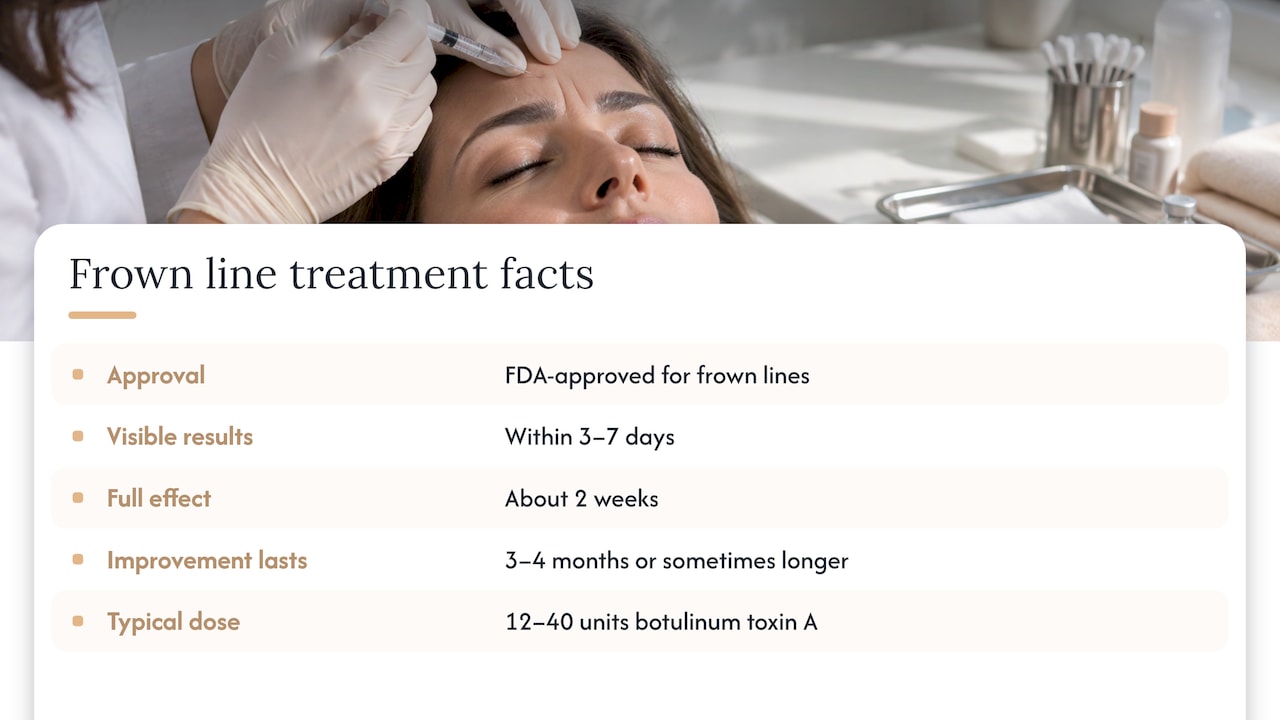
For the vertical lines between the brows, neuromodulators are the established choice. The American Academy of Dermatology states that botulinum toxin therapy is FDA-approved to treat frown lines between the eyebrows, that most people see results within 3 to 7 days, that you can return to everyday activities right away, and that improvements last about 3 to 4 months and sometimes longer.
The American Family Physician’s May 2026 review adds that the effect takes about 2 weeks to fully develop, and that treating dynamic wrinkles (the ones visible when the muscle contracts) tends to give more dramatic results than treating static wrinkles visible at rest. That is a practical argument for starting early rather than waiting until the lines are etched in.
How much product is used depends on your anatomy. The Global Aesthetics Consensus describes three to seven injection points in the glabellar area with total doses typically from 12 to 40 units of botulinum toxin A. Your injector sets the dose for your muscle strength and your goals. If you want to understand how pricing works, our Botox cost and per-unit math breakdown explains why two quotes can look different. For the upper face more broadly, see Botox for forehead lines.
Some frown lines have settled into deep static creases. In those cases a neuromodulator relaxes the muscle first, and a provider may then discuss filler or skin treatments for what remains.
Lines around the mouth
Fine lines above the lips respond to a different approach than marionette lines. The 2023 consensus describes 4 to 6 small intradermal injection points above the lip border, a total of 4 to 12 units, starting conservatively and reassessing at 2 weeks. It also advises keeping the outer points at least 1.5 cm from the mouth corners to protect smiling, eating and speech. The same document is realistic about outcomes: complete wrinkle removal is not the goal, and combining a neuromodulator with filler, laser or peels often gives the best result.
The placement detail is the part worth remembering. Perioral injections sit close to muscles you use constantly, so dose and position matter far more than in the forehead. This is where an experienced injector earns their fee. If swelling is a concern after lip-area treatment, our guide to lip filler swelling stages explains what to expect from the first 24 to 72 hours.
What skin care and lifestyle can do
Daily habits support every injectable result. Harvard Health notes that wrinkles deepen with repeated expressions, sun exposure and gravity, that retinoids boost collagen and smooth the skin’s outer layer, and that daily broad-spectrum sunscreen of SPF 30 or higher is among the most important steps for slowing skin aging. Prescription retinoids such as tretinoin come through a clinician, while retinol and retinal are sold over the counter.
In San Antonio, where UV exposure is high for much of the year, sunscreen is the habit that protects the investment you make in treatment. Think of skin care as maintenance: it keeps the surface healthy while injectables address the structure and the muscle.
What to expect from treatment
Results and timing
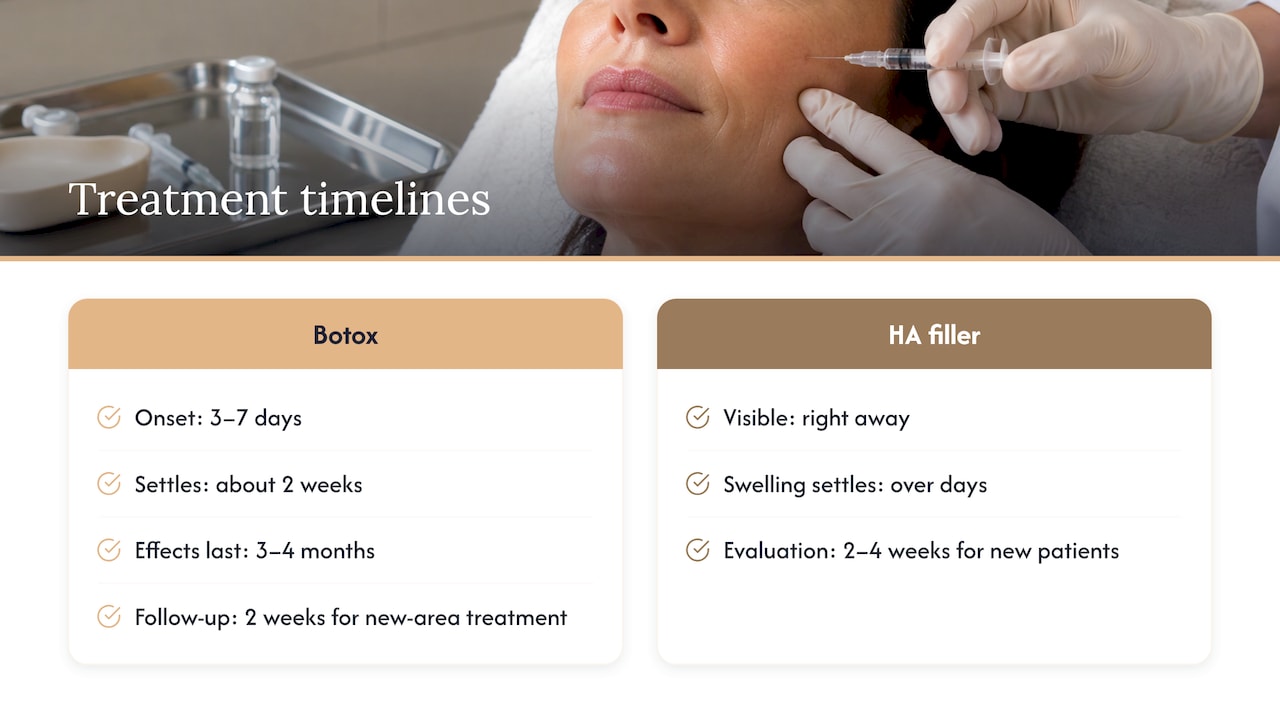
Botox usually shows in 3 to 7 days and settles over about 2 weeks, with effects lasting roughly 3 to 4 months. Hyaluronic acid filler is visible right away and swelling settles over days. A 2020 consensus in the Australasian Journal of Dermatology recommends that new patients return 2 to 4 weeks after filler for evaluation and a possible touch-up, and a 2-week follow-up for first-time or new-area neuromodulator treatment. Plan for that visit rather than judging the result on day one.
Aftercare
The same consensus recommends written aftercare instructions and, after filler, avoiding makeup for 2 hours and strenuous activity for 24 hours, not sleeping face-down or rubbing the face for a week, and massaging the area for 2 weeks if your provider directs it. For Botox, patients can generally resume normal activities after about 4 hours. The Global Aesthetics Consensus found no evidence to support older rules about avoiding exercise, pressure on the area or air travel after neuromodulator injections, and noted that brief cold packs can limit swelling and bruising.
Common side effects
The FDA lists common filler side effects as bruising, redness, swelling, pain, tenderness, itching and rash, usually resolving in days to weeks. Common Botox effects include injection-site pain, bruising, tenderness and headache.
Safe use: who injects, and when to call
Injectables are medical procedures, and the safest way to have them is with a licensed, trained injector in a medical setting using FDA-approved products. The FDA specifically warns against buying fillers sold directly to the public, injecting yourself, and using needle-free devices.
Know these points before you book:
- Blood vessel risk. The FDA names accidental injection into a blood vessel as the most serious filler risk, which can cause skin tissue death, stroke or blindness. Hyaluronic acid fillers can be dissolved with an enzyme called hyaluronidase, which is one reason this filler type is so widely used.
- When to call right away. The 2020 consensus says to report increasing pain the day after injection, unusual bruising within 24 hours, or pustules or blisters within 3 days. Vascular problems can appear up to 72 hours after a hyaluronic acid filler. Contact your injector immediately, or go to emergency care if symptoms are severe.
- Health conditions. Botulinum toxin is contraindicated with keloidal scarring, neuromuscular disorders such as myasthenia gravis, or allergy to a product ingredient, according to the May 2026 American Family Physician review. Tell your provider about these and about any medications before treatment.
- Eyelid and brow position. Temporary eyelid or brow droop is a technique-dependent effect whose incidence falls as injector skill improves, which is why experience matters for frown line treatment in particular.
Choosing the right plan
Start with your goal and the line itself. A reasonable decision path:
- Vertical lines between the brows that appear when you frown: a neuromodulator is the first-line option.
- Folds from the mouth corners toward the chin: hyaluronic acid filler for support, with a neuromodulator considered if the mouth corners turn down.
- Fine lines above the lips: low-dose neuromodulator, filler or skin resurfacing, often in combination.
- Several areas at once: a staged plan with a follow-up visit, so each treatment can be judged on its own.
Most people do best with a combination, because the lines on one face come from muscle, volume and skin quality together. Ask for a plan that names each area and the product for it, and for a follow-up visit built into the schedule.
Your next step in San Antonio
If you are weighing treatment for marionette lines, frown lines or lines around the mouth, we offer facial fillers and Botox at Luna Regenerative Wellness in San Antonio, delivered in an aesthetic and wellness clinic setting. Our facial fillers page is the best place to start, and you can reach us through our main site to arrange a consultation.

We are also co-located with a trusted OBGYN practice, and our wellness services range from hormone therapy with Biote to medical weight loss, so face and whole-body goals can be discussed in one place.
Our perspective
Lines are rarely just a skin problem. A fold beside the mouth is often a sign that the lower face has lost support, and a crease between the brows is often a sign of a strong, habitual muscle. Treating them well means treating the cause, not just the crease.
That is why we think of aesthetic care as part of a larger picture. Our model brings advanced aesthetic treatments together with personalized wellness strategies, so a conversation about your face can sit next to a conversation about how you feel overall. We offer facial fillers and Botox because the combination covers both of the mechanisms behind these lines: structure and movement.
We would rather plan a result you can maintain than chase a dramatic change in one visit. Start with the area that bothers you most, build in the follow-up, and let the plan grow from there.
Luna Regenerative Wellness
FAQ
What is the best treatment for marionette lines?
Hyaluronic acid filler is the most common treatment, because marionette lines come largely from lost volume and support in the lower face. When the mouth corners also turn down, a small dose of neuromodulator in the depressor anguli oris can be added. A provider will assess your face to decide the combination.
Is filler or Botox better for marionette lines?
They do different jobs. Filler adds support under the fold, while Botox relaxes the muscle that pulls the mouth corners down. For many people the two work best together, planned by one trained injector.
How long do results last?
Botox for frown lines typically lasts about 3 to 4 months, sometimes longer, according to the American Academy of Dermatology. Hyaluronic acid fillers are temporary because the body gradually breaks them down, so treatment is repeated over time. Your provider can give you a schedule for your area and product.
How can I reduce frown lines or marionette lines at home?
Daily broad-spectrum sunscreen of SPF 30 or higher and a retinoid are the habits Harvard Health highlights for slowing skin aging and smoothing the surface. These support healthy skin. For lines that are visible at rest, an in-clinic treatment addresses the muscle or the volume behind them.
Is there downtime after treatment?
After Botox you can return to everyday activities right away, with normal activity after about 4 hours per the 2020 consensus. After filler, expect some swelling or bruising for days and avoid makeup for 2 hours and strenuous activity for 24 hours. Call your injector promptly for increasing pain, unusual bruising or blisters.
Sources
- Evaluation and Treatment Planning for the Aging Face Patient, Facial Plastic Surgery Clinics of North America, 2022
- Frown Lines: What They Are and How to Get Rid of Them, WebMD
- Botulinum Toxin Injection for Facial Wrinkles, American Family Physician, 2014
- Dermal Filler Do’s and Don’ts for Wrinkles, Lips and More, FDA
- International Consensus Recommendations on the Aesthetic Usage of Botulinum Toxin Type A, Aesthetic Surgery Journal, 2023
- Botulinum Toxin Therapy: Overview, American Academy of Dermatology
- Botulinum Toxin Procedures: A Practical Approach, American Family Physician, May 2026
- Global Aesthetics Consensus: Botulinum Toxin Type A, Plastic and Reconstructive Surgery
- Facial Aesthetic Injections in Clinical Practice, Australasian Journal of Dermatology, 2020
- Skin Care for Aging Skin, Harvard Health, 2024